How To Plant A Tree
When planting trees, there are a few things to understand before installing. Consider the placement of each tree and note their growth habits (size, height, water and sun requirements, soil pH, sand and clay percentage in the soil, etc.) as these will all affect the health of your tree. Natives are resilient, but still need special care when planting! Once you’re happy with your selections, make sure to follow these steps:
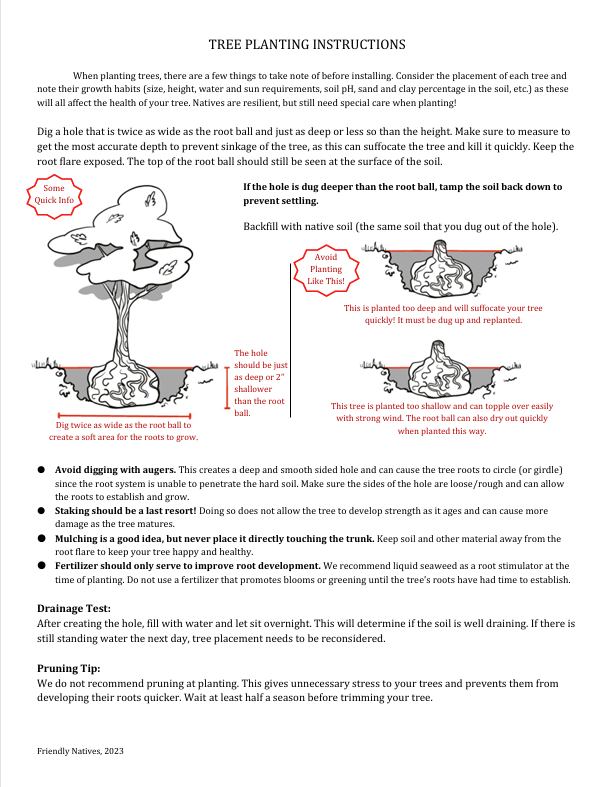
Dig a hole that is twice as wide as the root ball and just as deep or less so than the height. Make sure to measure to get the most accurate depth to prevent sinkage of the tree, as this can suffocate the tree and kill it quickly. It is best to avoid having to backfill to raise the height, and instead allow your tree’s rootball to sit firmly on existing soil. If you accidentally dig too deep, make sure to firmly tamp down the soil that you replace back on the bottom of the hole.
To give you an idea of measurements, a typical 15 gallon size tree might have a root ball diameter of roughly 18” and a height of 12”-16”. A 45 gallon tree might have a rootball diameter of roughly 30” and a height of 14”-20”.
Keep the root flare exposed. The what? If you think of the rounded corner that forms where the vertical trunk meets the horizontal root…that’s the root flare. You never want your tree’s trunk and the surrounding soil to form a 90 degree angle. That would indicate that it’s planted too deep, and/or there is too much soil or mulch piled up around the trunk. The top of the root ball should still be seen at the surface of the soil.
Make it ugly. The hole should have rough, jagged sides. Irregular shape is preferable. Smooth sides make it hard for the tree’s roots to grab hold and can cause them instead to circle around the nice smooth walls.
Backfill with native soil. Once you’ve placed your tree in the hole, on a firm, compacted base, backfill with the same soil that came out of that hole. It might be tempting to use nice soft, rich soil but in most cases, we don’t recommend it! You want to avoid the “bathtub effect”, which is what happens when water doesn’t easily absorb into surrounding soil and roots don’t easily penetrate the walls of the hole because they much prefer the easily maneuverable soft soil. Waterlogged soil and circling roots are bad. We don’t want that for you.
If your tree is one that likes richer soil, you can apply a layer of compost to the top once you’ve backfilled. This is preferable to backfilling with amended soil.
Mulch. Apply a thick layer on top of the rootball. Make sure to clear several inches from around the trunk, like a donut. If you’re using a compost topdressing, put the compost down first, with the mulch on top.
Some things to consider:
If you’re concerned about drainage in the location you’ve selected, do a drainage test- fill the hole with water and let it sit overnight. If it still has water the next morning, you’ll need to choose a new spot for your tree. The poor draining soil will not be a healthy environment for roots to grow.
Augers tend to make very smooth holes…which you don’t want! If you do use an auger, make sure to rough up the sides. It’s also easy to over-dig when using an auger. Keep in mind the depth you want and remember it’s always better to plant slightly too shallow than too deep!
Fertilizer should only serve to improve root development. Trees go through enough shock being transplanted; they don’t need to put energy into leaves and blooms until the roots are settled. We recommend liquid seaweed as a root stimulator at the time of planting.
Here’s an illustrated guide that we made. Take a look!